

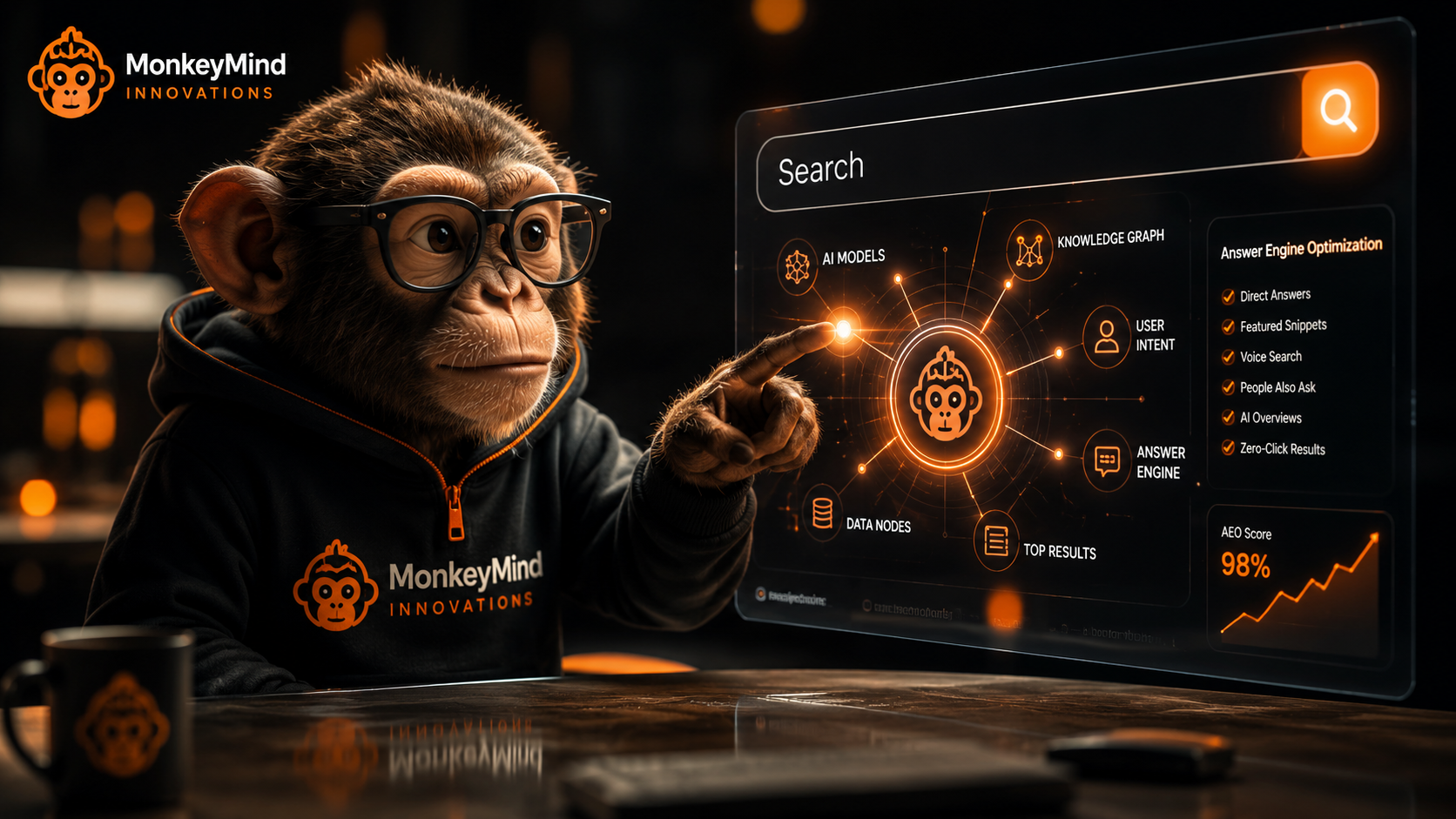
What is AEO? The Complete Beginner’s Guide to Answer Engine Optimization
Search has fundamentally changed. Users no longer want a list of ten blue links; they want instant, accurate answers.
With the rise of AI Overviews, ChatGPT, Gemini, and Claude, traditional SEO is no longer enough to maintain visibility.
Welcome to the era of Answer Engine Optimization (AEO). Let’s dive in.
Answer Engine Optimization (AEO) is the process of optimizing content to be easily understood, extracted, and cited by AI search engines, voice assistants, and chatbots.
Unlike traditional SEO, which focuses on ranking web pages, AEO focuses on providing direct, semantic, and authoritative answers to specific user queries.
The Shift from Search Engines to Answer Engines
For two decades, Google operated primarily as a search engine, acting as a digital librarian.
You typed in a query, and it handed you a list of relevant websites. You had to do the reading.
Today, platforms like Perplexity and Google’s Generative AI act as answer engines, synthesizing information for you.
Why Generative Engine Optimization Matters
Generative Engine Optimization (GEO) and AEO are quickly becoming the most critical skills for digital marketers.
If your content isn’t structured to be read by Large Language Models (LLMs), your brand will become invisible.
AI search optimization strategy ensures that when an AI model formulates a response, it cites your website as the source.
Traditional SEO aims to get a user to click a link and visit a webpage.
Answer Engine Optimization (AEO) aims to be the definitive source of truth that an AI engine quotes directly.
SEO focuses on keywords and backlinks; AEO focuses on semantics, entities, and conversational clarity.
Core Pillars of an AI Overview Optimization Strategy
To succeed in the AEO era, you need to rethink how you structure and write your content.
AI models do not “read” pages like humans; they process entities, relationships, and structured data.
Here are the non-negotiable pillars of a future-proof AEO strategy.
1. Direct, Conversational Formatting
AI search engines parse content by looking for direct answers to specific questions.
Stop burying your answers under layers of fluff. State the answer clearly in the first sentence.
Use short paragraphs. Keep your sentence structure simple and highly readable.
2. Semantic SEO for AI
Semantic SEO involves building topical authority by covering a subject comprehensively.
Instead of repeating the exact keyword, use related entities and concepts.
If you are writing about AEO, you must mention LLMs, NLP, knowledge graphs, and voice search.
3. EEAT (Experience, Expertise, Authoritativeness, Trustworthiness)
AI models are trained to prioritize high-trust sources to avoid AI hallucinations.
Your content must demonstrate firsthand experience and deep expertise.
Author bios, expert quotes, and citations of primary data are mandatory for AEO success.
How to Optimize for AI Search (Step-by-Step)
Ready to implement Answer Engine Optimization? Follow this actionable blueprint.
- Implement Schema Markup: Use JSON-LD structured data (like FAQ, Article, and HowTo) to feed data directly to AI parsers.
- Target Question Keywords: Use “Who, What, Where, When, Why, and How” queries in your H2 and H3 tags.
- Optimize for Voice Search: Write exactly how people speak. Conversational tones win in AEO.
- Structure with Clarity: Use bulleted lists, numbered sequences, and data tables to make information digestible.
- Build Topical Maps: Cluster your content. Do not just write one article; write a hub of interconnected content.
Always include a “TL;DR” or a “Key Takeaways” bulleted list at the very top of your long-form content.
AI bots aggressively scan the top 20% of your page to summarize content for AI Overviews and ChatGPT search.
Comparing Traditional SEO to Answer Engine Optimization
Understanding the difference is crucial for adjusting your content strategy.
Here is a breakdown of how the two methodologies compare in practice.
| Feature | Traditional SEO | Answer Engine Optimization (AEO) |
|---|---|---|
| Primary Goal | Drive clicks to a website | Provide direct answers within the engine |
| Content Format | Long-form, keyword-dense articles | Concise, structured, and factual snippets |
| Key Metric | Organic Traffic & Click-Through Rate | Brand Mentions & AI Citations |
| Search Interface | Ten blue links (SERPs) | Conversational UI & Voice Assistants |
Real Examples of AEO in Action
Let’s look at how AEO transforms content delivery for modern brands.
Imagine a user asking Claude or ChatGPT: “What is the best SaaS architecture for an AI startup?”
If MonkeyMind Innovations has a poorly structured, keyword-stuffed page, the AI ignores it.
However, if MonkeyMind has an article with a clear H2 and a bulleted list answering that exact prompt, the AI will pull our data and cite us.
The Future: AEO is Generative Engine Optimization
Generative Engine Optimization (GEO) is the next evolution of this concept.
It means optimizing not just for pre-indexed answers, but for real-time generative responses.
To prepare, ensure your technical SEO is flawless, your site speed is instant, and your content is uniquely valuable.
Conclusion
Answer Engine Optimization is no longer an optional tactic; it is the foundation of modern digital visibility.
By embracing semantic SEO, clear formatting, and authoritative writing, you future-proof your website.
Start optimizing for AI search today, and position your brand as the definitive answer in your industry.
Ready to Dominate AI Search Results?
At MonkeyMind Innovations, we build advanced SEO and AEO strategies for forward-thinking brands.
Stop chasing algorithms and start capturing AI citations.
Get Your Free AEO Audit TodayFrequently Asked Questions
Everything you need to know about Answer Engine Optimization (AEO).
Answer Engine Optimization (AEO) is the strategy of structuring and writing digital content so that it can be easily extracted, understood, and cited by AI engines like ChatGPT, Gemini, and Google’s AI Overviews. It focuses on providing direct, authoritative answers to user queries.
While traditional SEO focuses on optimizing web pages to rank higher on search engine result pages (SERPs) to generate clicks, AEO focuses on providing concise, factual answers directly within the AI interface. SEO relies heavily on backlinks and keywords, whereas AEO relies on entities, semantics, and structured data.
Search behaviors are shifting from browsing lists of links to having conversations with AI assistants. AEO is vital because if your content is not optimized for AI readability, your brand will lose visibility entirely in generative search experiences and voice search.
No, AEO does not replace SEO; it builds upon it. Strong technical SEO, site speed, and authoritative backlinks are still required to get crawled and indexed. AEO is the next layer of optimization that ensures your indexed content is selected by AI models for answers.
Any system utilizing Large Language Models (LLMs) and retrieval-augmented generation (RAG) uses AEO principles. This includes Google AI Overviews, OpenAI’s ChatGPT Search, Anthropic’s Claude Search, Perplexity AI, Microsoft Copilot, and voice assistants like Alexa and Siri.
To optimize for Google AI Overview, structure your content with clear H2 and H3 tags phrased as questions. Provide a direct, 40-50 word answer immediately following the heading. Use structured data (Schema markup), maintain high EEAT signals, and use bulleted lists for easy AI extraction.
EEAT (Experience, Expertise, Authoritativeness, and Trustworthiness) is critical for AEO. AI models are trained to prevent hallucinations and misinformation by giving massive weight to highly trusted, expert-authored sources. Demonstrating real-world expertise makes an AI model much more likely to cite your content.
Semantic HTML (like using proper header hierarchies, article tags, lists, and tables) helps AI parsers understand the relationship between different pieces of content on your page. Clean semantic structure acts as a roadmap, allowing the AI to extract your answers without confusion.
Absolutely. Small businesses can dominate local AEO by answering highly specific, niche-related questions that major brands ignore. By creating incredibly helpful FAQ pages and conversational content, small businesses can become the primary citation for AI queries in their local market.
Since users interact with AI engines using natural, conversational language, your content should match that tone. Writing conversationally—using natural phrasing, avoiding corporate jargon, and directly addressing the user’s intent—aligns perfectly with Natural Language Processing (NLP) models.
Generative Engine Optimization (GEO) is a subset of AEO focused specifically on optimizing content for generative AI engines (like ChatGPT or Gemini) that construct unique, real-time answers rather than simply retrieving pre-existing text. It requires deep semantic relevance and high authoritative signals.
To optimize for ChatGPT search, ensure your content is publicly accessible (not blocked by robots.txt), frequently updated, and rich in unique data or statistics. Use a clear “Problem-Solution” structure, and provide comprehensive summaries at the beginning of your articles.
Yes, featured snippets were the precursor to full Answer Engine Optimization. Optimizing for “Position Zero” snippets uses the exact same tactics as AEO: clear formatting, direct answers, and semantic HTML. Winning a featured snippet often means you will also be cited in an AI Overview.
Backlinks remain a powerful trust signal. AI search engines use link graphs to determine the authority of a source. While AEO relies heavily on on-page semantics, high-quality backlinks validate your content’s credibility, making an AI model more likely to trust and cite your answers.
For AEO keyword research, focus on tools that uncover questions and intent. AnswerThePublic, AlsoAsked, and Google’s “People Also Ask” sections are excellent. Traditional tools like Ahrefs and Semrush are useful, but you must filter for informational, question-based modifiers.
Voice search relies entirely on answer engines. When a user asks a smart speaker a question, it reads a single answer aloud. AEO is the methodology used to become that single, spoken answer by optimizing for natural language and concise formatting.
Absolutely. FAQPage JSON-LD schema is one of the most effective tools for AEO. It explicitly tells the search engine crawler what the question is and exactly what the answer is, removing any guesswork for the AI parsing your page.
AEO results timeline depends on your existing domain authority and indexation speed. For an established site, implementing AEO formatting can result in AI citations and featured snippets within a few weeks. For newer sites, establishing the necessary EEAT can take several months.
Common mistakes include keyword stuffing, writing long rambling introductions before answering the prompt, neglecting technical SEO, failing to use schema markup, and writing in a robotic tone rather than a conversational, authoritative one.
MonkeyMind Innovations specializes in future-proofing digital assets. As a full-stack SaaS and digital marketing agency, we handle everything from technical SEO audits and semantic content strategy to advanced structured data implementation, ensuring your brand dominates generative AI search results.
Leave a Reply