

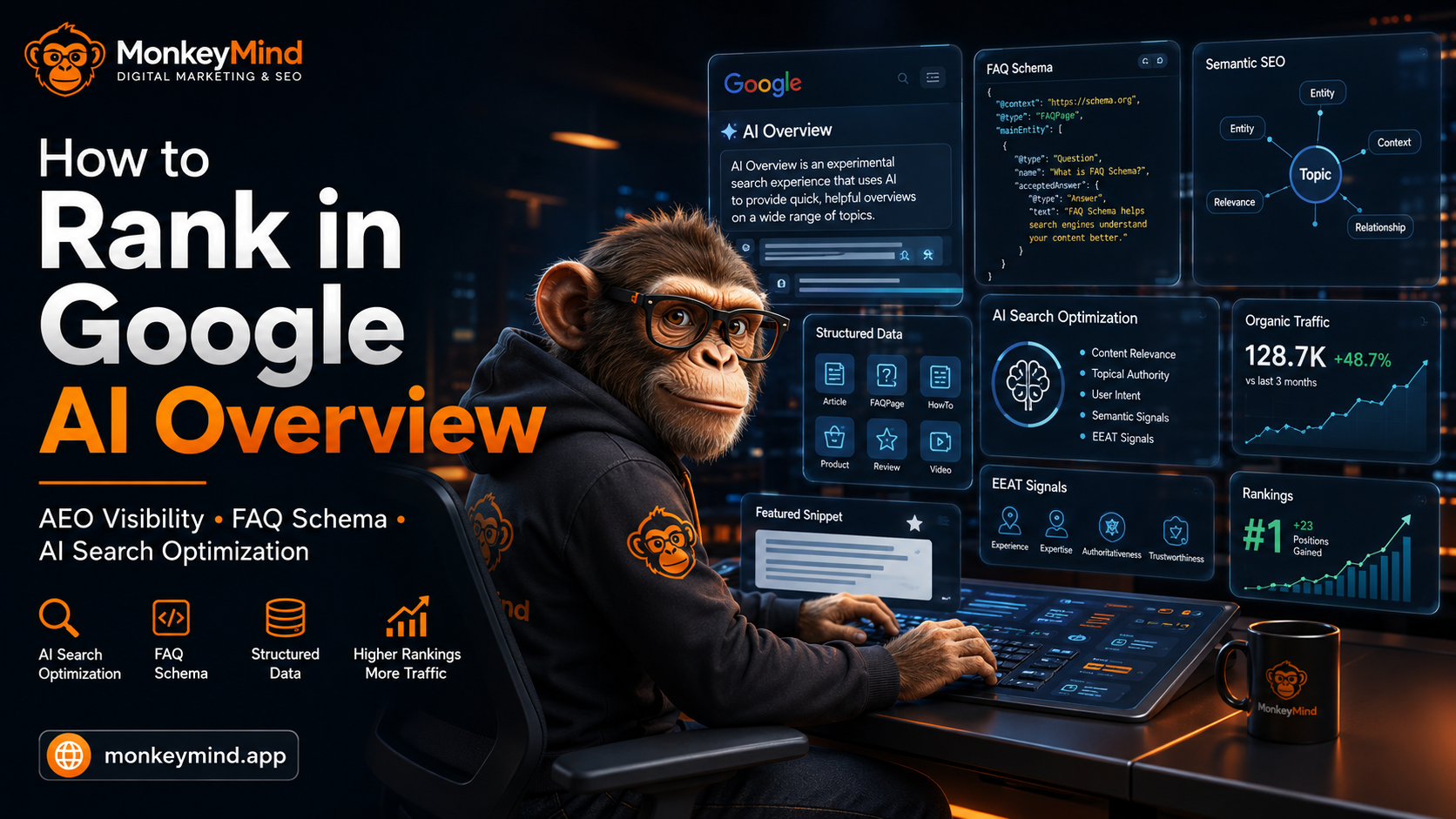
How to Rank in Google AI Overview
Google Search is changing faster than ever. Instead of showing only traditional blue links, Google now displays AI-generated answers through Google AI Overview. These answers appear above many organic search results and often become the first thing users see.
For website owners, marketers, bloggers, and businesses, this creates a new challenge and opportunity. The goal is no longer just ranking on page one. The goal is becoming the source that Google’s AI chooses to reference.
What is Google AI Overview?
Google AI Overview is an AI-generated summary displayed directly within search results. It gathers information from multiple trusted sources and provides users with quick answers without requiring them to visit several websites.
To rank in Google AI Overview, create helpful content that directly answers user questions, implement FAQ schema, build topical authority, improve EEAT signals, and structure content clearly for AI systems.
Why Traditional SEO is No Longer Enough
Traditional SEO focused heavily on backlinks, keyword density, and rankings. While these factors still matter, AI search engines now evaluate content differently.
Google’s AI wants content that is:
- Easy to understand
- Well-structured
- Factually accurate
- Written by trustworthy sources
- Focused on solving user intent
1. Create Content Around Questions
Google AI Overview frequently pulls information from pages that answer specific questions. Instead of targeting only keywords, target questions users actually ask.
Examples:
- What is AEO?
- How does AI Overview work?
- How can I improve AI search visibility?
- Why is schema markup important?
2. Use FAQ Sections and FAQ Schema
FAQ sections help search engines understand question-answer relationships. This structure closely matches how AI systems process information.
Adding FAQ schema provides additional context and increases content clarity for Google.
Benefits of FAQ Schema
- Better AI understanding
- Improved search visibility
- Rich result opportunities
- Voice search optimization
- Featured snippet potential
3. Build Topical Authority
Google prefers websites that demonstrate expertise on an entire topic rather than a single article.
For example, instead of publishing only one article about AI SEO, create a content cluster:
- What is AEO?
- Google AI Overview Guide
- FAQ Schema Tutorial
- Semantic SEO Guide
- EEAT Optimization Guide
- AI Search Ranking Factors
When these articles link together, Google sees your website as an authority on AI search optimization.
4. Improve EEAT Signals
EEAT stands for Experience, Expertise, Authoritativeness, and Trustworthiness.
AI systems prefer content from trusted sources. Add:
- Author information
- Real-world examples
- Case studies
- Testimonials
- Company information
- Reliable references
5. Write Human-First Content
Many websites still create content purely for search engines. AI systems increasingly favor content that sounds natural and genuinely helpful.
Avoid keyword stuffing. Focus on explaining concepts clearly and solving user problems.
6. Optimize Internal Linking
Internal links help Google understand relationships between pages.
For example, this article should link to:
- FAQ Schema Generator
- SEO Audit Tool
- AEO Guide
- Meta Tag Generator
- XML Sitemap Generator
- AI SEO Resources
Final Thoughts
Ranking in Google AI Overview requires a different mindset than traditional SEO. Success comes from becoming a trusted answer source rather than simply chasing rankings.
By combining AEO visibility, FAQ schema SEO, topical authority, semantic optimization, EEAT signals, and user-focused content, businesses can significantly improve their chances of appearing inside AI-generated search experiences.
🚀 Start Optimizing for AI Search Today
Explore free SEO tools, AI optimization resources, and digital marketing guides to improve your Google AI Overview visibility.
Frequently Asked Questions
1. What is Google AI Overview?
Google AI Overview is an AI-generated search feature that summarizes information from trusted websites and displays direct answers above traditional search results.
2. How can I rank in Google AI Overview?
Create helpful content, answer user questions clearly, use FAQ schema, build topical authority, and improve EEAT signals across your website.
3. What is AEO visibility?
AEO (Answer Engine Optimization) focuses on helping AI search engines understand and display your content as direct answers.
4. Does FAQ schema help AI rankings?
Yes. FAQ schema improves content understanding and increases the chances of appearing in AI-generated search experiences.
5. What type of content works best for AI Overview?
Human-written, structured, experience-based, and question-focused content performs best in AI-powered search results.
6. Is traditional SEO still important?
Yes. Traditional SEO remains important, but combining it with AEO and AI search optimization delivers stronger results.
7. What is EEAT in SEO?
EEAT stands for Experience, Expertise, Authoritativeness, and Trustworthiness, which are important quality signals for Google.
8. Can small websites appear in AI Overview?
Yes. Small websites can appear if they publish trustworthy, relevant, and well-structured content.
9. What is topical authority?
Topical authority is built by covering a topic comprehensively through multiple related articles and internal links.
10. How does internal linking help AI SEO?
Internal links help search engines understand relationships between pages and improve topic relevance.
11. Does schema markup improve SEO?
Schema markup helps search engines understand content better and can increase visibility in rich results.
12. What are AI search engines?
AI search engines use artificial intelligence to generate answers and recommendations instead of only showing links.
13. Can AI-generated content rank?
AI-generated content can rank if it is accurate, valuable, original, and properly reviewed by humans.
14. What is semantic SEO?
Semantic SEO focuses on topic relevance, search intent, and contextual relationships rather than keyword repetition.
15. How important are headings for AI SEO?
Clear headings help AI systems understand content structure and improve readability for users.
16. What are featured snippets?
Featured snippets are highlighted answers displayed above search results for specific queries.
17. How can I improve AI search visibility?
Focus on structured content, schema markup, user intent, EEAT signals, and helpful answers.
18. What is Google AI SEO?
Google AI SEO involves optimizing content for AI-powered search features such as AI Overview and Search Generative Experience.
19. Why is user intent important?
User intent helps search engines determine whether your content provides the most relevant answer.
20. What is the future of SEO?
The future of SEO will combine traditional optimization, AI search visibility, semantic SEO, and answer engine optimization.
Leave a Reply