

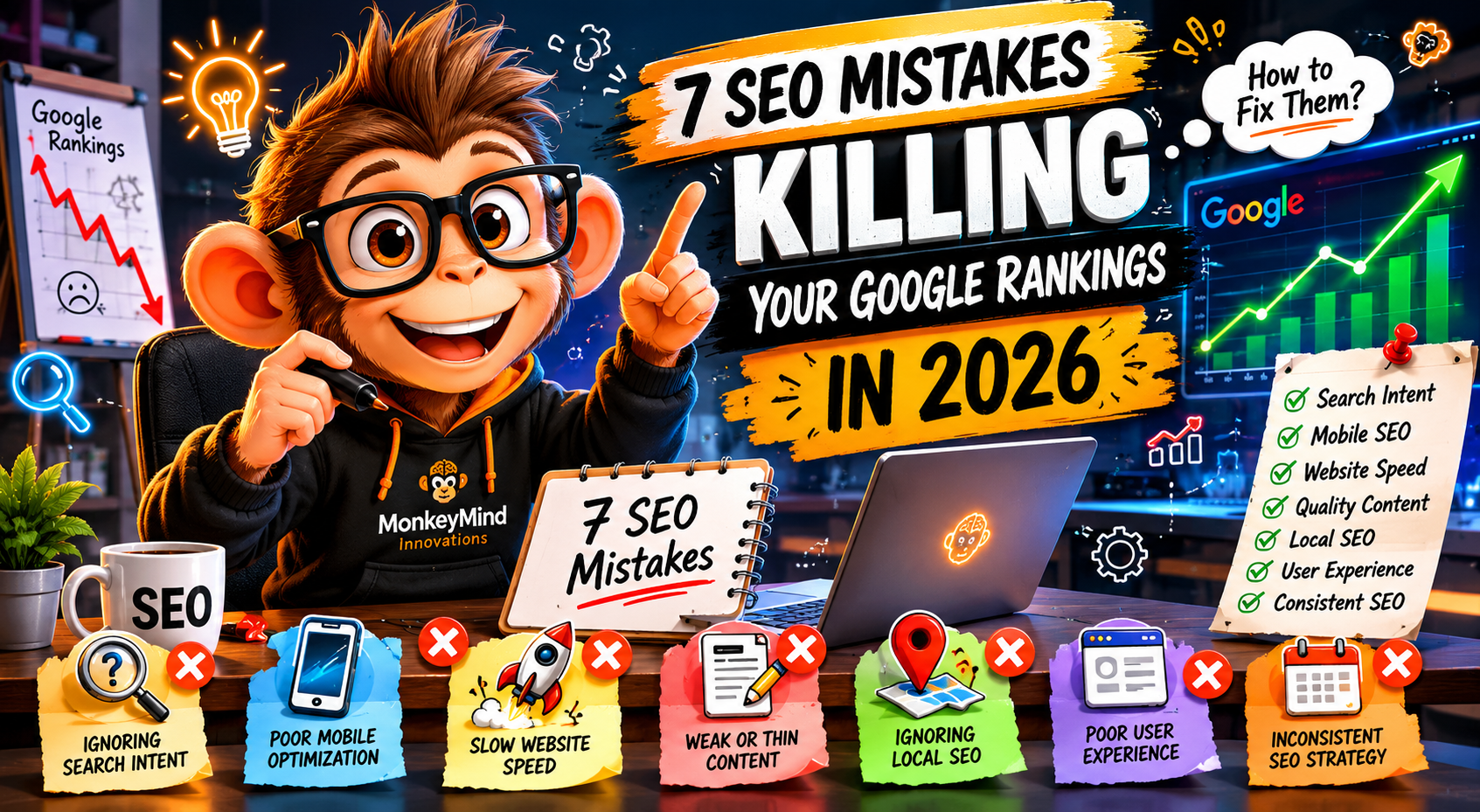
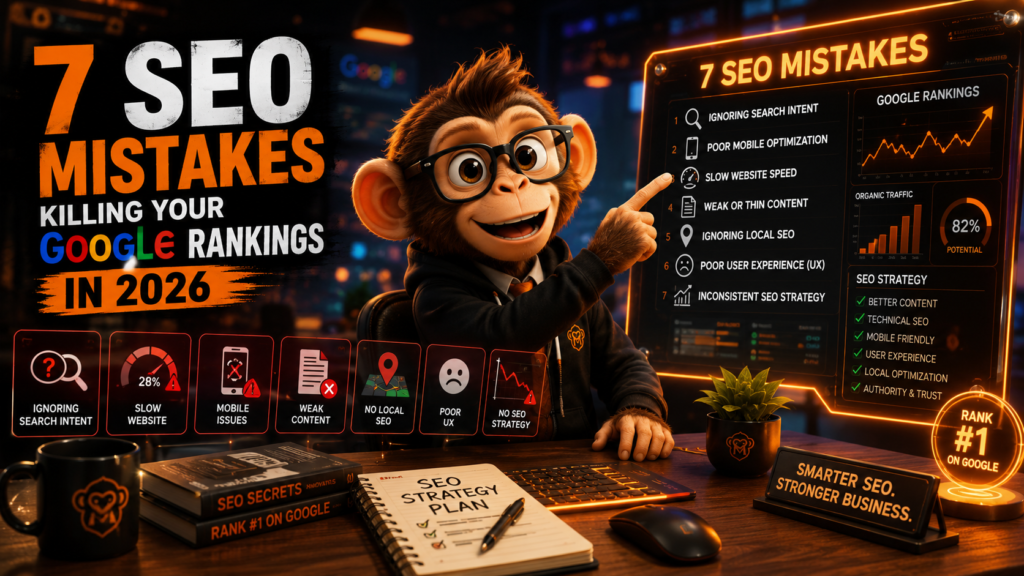
7 SEO Mistakes Killing Your Google Rankings in 2026
Ranking on Google in 2026 is no longer just about inserting a few keywords into your website.
Search engines are smarter, competition is tougher, and users expect fast, valuable, and seamless online experiences. Businesses that fail to adapt are seeing declining traffic, lower visibility, and poor search rankings.
The reality is simple:
Even a visually stunning website can struggle if its SEO foundation is weak.
If your website traffic is dropping or your business is not appearing on Google search results, there’s a strong chance you’re making one or more critical SEO mistakes.
In this guide, we’ll break down the 7 biggest SEO mistakes that are hurting Google rankings in 2026 and how you can fix them.
1. Ignoring Search Intent
One of the biggest SEO mistakes businesses make is targeting keywords without understanding what users actually want.
Google now prioritizes content that matches search intent rather than content that simply repeats keywords.
Example:
If someone searches for:
“Best dentist near me”
They are looking for:
- Nearby clinics
- Reviews and ratings
- Appointment booking options
- Contact information
They are not searching for a long article about the history of dentistry.
Why Ignoring Search Intent Hurts SEO
When users land on your website and quickly leave because the content does not answer their query, Google interprets it as a poor user experience.
This can lead to:
- Lower rankings
- Reduced organic traffic
- Higher bounce rates
How to Fix It
- Understand user intent before creating content
- Use problem-solving headlines
- Answer questions clearly and quickly
- Structure content for readability
2. Poor Mobile Optimization
Most searches in 2026 happen on smartphones and tablets, yet many websites still offer poor mobile experiences.
Common issues include:
- Slow loading speed
- Broken layouts
- Tiny unreadable text
- Difficult navigation
Google uses mobile-first indexing, meaning your mobile website matters more than your desktop version.
Why Mobile SEO Matters
A bad mobile experience can directly impact:
- Rankings
- User engagement
- Conversions
- Bounce rates
Mobile SEO Best Practices
- Use responsive website design
- Optimize images and layouts
- Improve mobile page speed
- Use clickable buttons and simple navigation
A mobile-friendly website improves both SEO performance and user satisfaction.
3. Slow Website Speed
Website speed has become one of the most important Google ranking factors.
Users expect websites to load instantly. If your site takes too long, visitors leave before engaging with your content.
Common Reasons for Slow Websites
- Heavy image files
- Cheap hosting
- Too many plugins
- Unoptimized code
- Excessive scripts
How Slow Speed Affects SEO
A slow website negatively impacts:
- User experience
- Organic rankings
- Conversion rates
- Engagement metrics
How to Improve Website Speed
- Compress images
- Use fast hosting
- Minimize unnecessary plugins
- Enable caching
- Optimize CSS and JavaScript
Fast websites create better user experiences and stronger SEO performance.
4. Publishing Weak or Thin Content
Low-quality content no longer works in modern SEO.
Google now prioritizes:
- Helpful content
- Original insights
- Expert information
- User-focused content
Unfortunately, many websites still publish:
- Generic blog posts
- AI-generated spam content
- Keyword-stuffed pages
- Thin articles with little value
What High-Quality Content Looks Like
Strong SEO content should:
- Solve real problems
- Answer user questions
- Provide unique insights
- Build trust and authority
Why Content Quality Matters
High-quality content helps increase:
- Google rankings
- Organic traffic
- Website authority
- User trust
Helpful content consistently outperforms shallow content in search results.
5. Ignoring Local SEO
Ignoring Local SEO is one of the biggest mistakes for:
- Clinics
- Hospitals
- Restaurants
- Salons
- Local service businesses
Without local optimization, businesses miss valuable high-intent traffic every day.
Common Local SEO Mistakes
- Incomplete Google Business Profile
- Wrong contact information
- Missing local keywords
- Lack of customer reviews
Why Local SEO Is Important
Searches like:
- “Best salon near me”
- “Dentist in Ludhiana”
- “Clinic near me”
…often lead to direct calls, bookings, and walk-ins.
Local SEO Tips
- Optimize your Google Business Profile
- Use location-based keywords
- Collect positive customer reviews
- Keep business information updated
Strong Local SEO helps businesses dominate nearby search results.
6. Poor User Experience (UX)
Modern SEO is no longer just about keywords and backlinks.
Google now evaluates how users interact with your website.
Factors That Affect User Experience
- Website navigation
- Readability
- Layout structure
- Page engagement
- Ease of use
If users struggle to find information or leave quickly, your rankings may decline.
How to Improve Website UX
- Use clean and modern layouts
- Add proper headings and spacing
- Break content into readable sections
- Use clear call-to-action buttons
- Make important information easy to find
Better user experience improves both SEO and conversion rates.
7. Inconsistent SEO and Content Strategy
Many businesses publish content randomly without a long-term SEO strategy.
SEO is not a one-time task. It requires:
- Consistent optimization
- Regular content updates
- Technical maintenance
- Keyword research
- Ongoing improvements
Common SEO Mistake
Many website owners publish a few blogs and expect instant rankings.
In reality, SEO is a long-term growth system.
How to Build a Strong SEO Strategy
- Create a monthly content plan
- Target relevant keywords consistently
- Update old content regularly
- Monitor technical SEO issues
- Track rankings and traffic performance
Consistency is what creates long-term organic growth.
Bonus SEO Mistake: Ignoring Reviews and Authority Signals
Google increasingly prioritizes trust and authority signals.
These include:
- Customer reviews
- Backlinks
- Brand mentions
- Local authority
- Online reputation
Businesses with stronger authority often outrank competitors, even when offering similar services.
How to Build Authority
- Collect genuine reviews
- Earn quality backlinks
- Publish expert-level content
- Build a strong brand presence online
Authority plays a major role in SEO rankings in 2026.
How to Fix These SEO Mistakes
Here are the most effective ways to improve your SEO performance:
Focus on Search Intent
Create content based on what users actually want to find.
Improve Website Speed
Fast-loading websites improve rankings and user experience.
Prioritize Mobile SEO
Mobile optimization is essential for modern search rankings.
Publish High-Quality Content
Helpful and original content performs best on Google.
Strengthen Local SEO
Optimize your business for local search traffic and map visibility.
Build a Consistent SEO System
Long-term SEO success comes from consistency and ongoing optimization.
Final Thoughts
SEO in 2026 is no longer about manipulating algorithms or stuffing keywords.
Successful SEO now depends on:
- User experience
- Valuable content
- Website performance
- Trust and authority
- Consistency
The businesses dominating Google search results are not always the biggest brands.
They are the ones delivering the best overall digital experience to users.
Conclusion
If your website is not ranking on Google, it does not mean SEO is dead.
In most cases, the real problem is avoidable SEO mistakes that quietly damage performance over time.
Fix the fundamentals, improve your content, optimize user experience, and stay consistent.
That’s how long-term Google rankings are built in 2026. 🚀
FAQs
1. What are the biggest SEO mistakes in 2026?
The biggest SEO mistakes in 2026 include ignoring search intent, poor mobile optimization, slow website speed, weak content, poor user experience, and inconsistent SEO strategies.
2. Why is search intent important for SEO?
Search intent helps Google understand whether your content matches what users are actually looking for. Content that satisfies user intent ranks better.
3. Does website speed affect Google rankings?
Yes, website speed is a confirmed Google ranking factor. Faster websites improve user experience, reduce bounce rates, and increase SEO performance.
4. How does mobile optimization improve SEO?
Google uses mobile-first indexing, meaning the mobile version of your website directly impacts rankings and visibility.
5. What is thin content in SEO?
Thin content refers to low-quality or low-value pages that provide little useful information to users. Google usually ranks such pages poorly.
6. Why is Local SEO important for businesses?
Local SEO helps businesses appear in nearby searches like “best salon near me” or “clinic in Ludhiana,” driving calls, bookings, and walk-ins.
7. How often should I update SEO content?
SEO content should be updated regularly to keep information fresh, improve rankings, and maintain relevance in search results.
8. Does user experience impact SEO rankings?
Yes, Google evaluates user experience signals like readability, navigation, and engagement to determine ranking quality.
9. Can AI-generated content hurt SEO?
Low-quality AI-generated content without originality or value can negatively impact rankings. Helpful and user-focused content performs better.
10. How long does SEO take to show results?
SEO is a long-term strategy. Most websites start seeing noticeable improvements within 3 to 6 months depending on competition and consistency.
Leave a Reply